Everyday Creativity Test
Do your ideas stay in your head, live in a notebook, or get out into the world? Pick the answers that sound most like your own days. In about five minutes you get a picture of your creative habits, not a score. Light in tone, honest in intent: answer as you are, not as you’d like to be.
No sign-up. Your result right away.
Window Seat
«Your days run straight, and there's calm in that.»
The test is new — you are among the first hundred to take it.
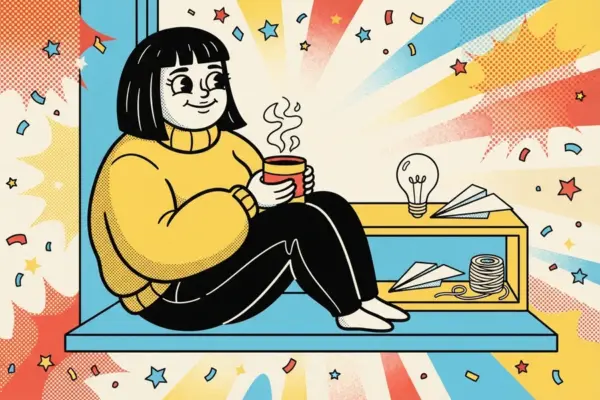
You have a free half hour, a mug of tea and a window, and your head fills with tomorrow's list. Nothing gets rigged, sketched or rewritten. Right now, creative behavior barely shows in your days.
Your plans and errands go from A to B without detours or spare versions, which means things get done while other people are still weighing options. The price is a thin pile of experiments, side-drafts and odd little builds.
Off camera: this describes how your time and attention run right now, and says nothing about what you could think up on a different schedule. Straight lines are a perfectly good way to live.

Full Sketchbook
«Your head is a workshop with the door shut.»
The test is new — you are among the first hundred to take it.
You're on the bus when an idea for a game, a fix or a nickname lands, and you spin it three ways before your stop. Then the stop arrives. Ideas and private creative moments fill your days; they rarely get made or shown.
Your strength is a rich private stream of options, with no cost of finishing or exposing any of them. This is a common, legitimate stage of the same road, not a failure to do something with your ideas. The flip side: a head full of half-built things gets heavy.
Off camera: you have no shortage of ideas, and what happens to them next is a separate habit. Having them and finishing them are two different skills at the same table.
Studio Table
«You turn ideas into things and keep them close.»
The test is new — you are among the first hundred to take it.
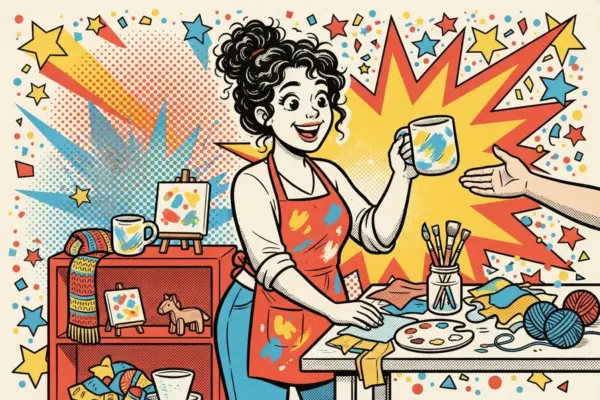
You glued and painted the cracked mug on your shelf, and the scarf beside it has its last row done. Most of it stops at your sofa. You regularly finish personal creative things, across more than one corner of life, and mostly keep them close.
You can count on a habit: an idea goes in one end and a real object comes out the other, and the flip side is a shelf of finished things that only your cat has met.
Off camera: this is a middle spot on the road from private to shown to recognized, not a fuzzy result, and plenty of honest positions sit here or earlier. Meanwhile the next mug is already on your workbench, half-glued.
Market Stall
«You make it, then you let people see it.»
The test is new — you are among the first hundred to take it.
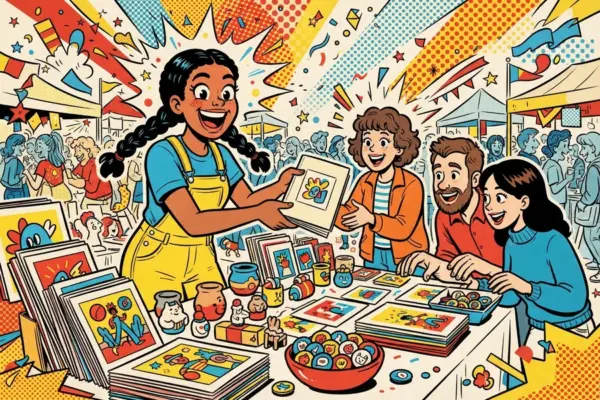
Your hand-drawn cards go to friends, and this month a street-fair table puts your work in strangers' hands. Your work moves between people, and now and then it lands with someone outside your close circle.
Creativity doesn't stay locked in your head: it travels, draws reactions, sometimes gets built on. The price is exposure, and you pay it again and again.
Off camera: this says how far your work travels, not how good anyone finds it. Some reactions are warm and some are a shrug. You keep setting the table anyway.

Opening Night
«People you have never met carry your work forward.»
The test is new — you are among the first hundred to take it.
Someone you've never met quotes your piece in a talk, a group you don't belong to asks for the next one, and an organiser emails you a date. Well outside your circle, people pick up what you make, and they keep doing it.
This is its own tier, not simply more of the tier before it: strangers with no stake in you pick your work up and pass it on.
The cost is upkeep: finishing and showing, round after round, with no coasting. Off camera, and it matters here: this is no measure of your talent, IQ or potential, just behavior and how far it has travelled. Wear it lightly.
About this test
How this test works
The creativity tests you may know hand you a task and rate the ideas you produce. This one borrows from a tradition of questionnaires about the creative things people do, so what comes back is self-report, a description of behavior. Such reports and direct thinking exercises line up only weakly to moderately, so the result is a portrait of habits, not a rating of ideas. Intelligence and creativity are only weakly related in pooled studies, and the link shifts with the side of creativity measured. The portrait covers how reliably you finish and show projects, how far your results travel from private to publicly recognized, how many areas of life it reaches, and how readily you play with ideas and the unusual. It says nothing about talent, potential or where you will end up. For a definition, see the APA Dictionary of Psychology entry on creativity.
Frequently asked questions
Is this the classic creativity test with idea-listing puzzles?
No. What you get is a report on the creative things you do, from a separate line of research. There are no idea-listing tasks and nobody scores your ideas; a quiz on a website cannot do either. Saying what you do and proving how good your ideas are are different questions, only loosely connected.
Are clever people more creative than everyone else?
It depends what you measure. Sheer volume of ideas and how good the best few are behave differently, and across pooled studies the overall connection with being clever is faint. There is no simple cutoff where one switches the other on.
Is creativity only about drawing and painting?
No. The things this test asks about range from home fixes and gadgets to words, music and fresh ways of thinking about a topic. Drawing is one corner of that map, and skipping it does not pull your result down by itself.
Can creativity be trained, or is it inborn?
This test does not measure an inborn endowment. It looks at habits, attitudes and how far your projects get carried through to a finished, shown state, all of which follow what you are doing at the moment. Your result is a snapshot of current behavior, and behavior moves.
Does the result say what type of creative person I am?
No. The result is one overall reading of how present creative behavior is in your days, not a label for your style. Whatever you are active in, from cooking to code, feeds the same single reading.
Sources
- Kaufman, J. C., & Beghetto, R. A. (2009). Beyond Big and Little: The Four C Model of Creativity. Review of General Psychology, 13(1), 1–12. doi:10.1037/a0013688
- Kaufman, J. C. (2012). Counting the muses: Development of the Kaufman Domains of Creativity Scale (K-DOCS). Psychology of Aesthetics, Creativity, and the Arts, 6(4), 298–308. doi:10.1037/a0029751
- Carson, S., Peterson, J. B., & Higgins, D. M. (2005). Reliability, Validity, and Factor Structure of the Creative Achievement Questionnaire. Creativity Research Journal, 17(1), 37–50. doi:10.1207/s15326934crj1701_4
- Runco, M. A., Plucker, J. A., & Lim, W. (2001). Development and psychometric integrity of a measure of ideational behavior. Creativity Research Journal, 13(3–4), 393–400. doi:10.1207/S15326934CRJ1334_16
Three more tests on the same theme

Breakdown
There's a reason you answer the way you do
Most tests show you a slice of who you are. This one gets to the core: the classic 16-type personality test that goes back to Carl Jung, rebuilt from the ground up and way more accurate. It takes ten minutes, you only ever do it once — and you walk away with an answer most people never quite figure out: why you are the way you are. Why some people just get you, and why with others it's complicated. And that answer won't change: your type is yours for life.
Take the free testHow you compare
The test is new — you are among the first hundred to take it.
Three more tests on the same theme
About this test
How this test works
The creativity tests you may know hand you a task and rate the ideas you produce. This one borrows from a tradition of questionnaires about the creative things people do, so what comes back is self-report, a description of behavior. Such reports and direct thinking exercises line up only weakly to moderately, so the result is a portrait of habits, not a rating of ideas. Intelligence and creativity are only weakly related in pooled studies, and the link shifts with the side of creativity measured. The portrait covers how reliably you finish and show projects, how far your results travel from private to publicly recognized, how many areas of life it reaches, and how readily you play with ideas and the unusual. It says nothing about talent, potential or where you will end up. For a definition, see the APA Dictionary of Psychology entry on creativity.
Frequently asked questions
Is this the classic creativity test with idea-listing puzzles?
No. What you get is a report on the creative things you do, from a separate line of research. There are no idea-listing tasks and nobody scores your ideas; a quiz on a website cannot do either. Saying what you do and proving how good your ideas are are different questions, only loosely connected.
Are clever people more creative than everyone else?
It depends what you measure. Sheer volume of ideas and how good the best few are behave differently, and across pooled studies the overall connection with being clever is faint. There is no simple cutoff where one switches the other on.
Is creativity only about drawing and painting?
No. The things this test asks about range from home fixes and gadgets to words, music and fresh ways of thinking about a topic. Drawing is one corner of that map, and skipping it does not pull your result down by itself.
Can creativity be trained, or is it inborn?
This test does not measure an inborn endowment. It looks at habits, attitudes and how far your projects get carried through to a finished, shown state, all of which follow what you are doing at the moment. Your result is a snapshot of current behavior, and behavior moves.
Does the result say what type of creative person I am?
No. The result is one overall reading of how present creative behavior is in your days, not a label for your style. Whatever you are active in, from cooking to code, feeds the same single reading.
Sources
- Kaufman, J. C., & Beghetto, R. A. (2009). Beyond Big and Little: The Four C Model of Creativity. Review of General Psychology, 13(1), 1–12. doi:10.1037/a0013688
- Kaufman, J. C. (2012). Counting the muses: Development of the Kaufman Domains of Creativity Scale (K-DOCS). Psychology of Aesthetics, Creativity, and the Arts, 6(4), 298–308. doi:10.1037/a0029751
- Carson, S., Peterson, J. B., & Higgins, D. M. (2005). Reliability, Validity, and Factor Structure of the Creative Achievement Questionnaire. Creativity Research Journal, 17(1), 37–50. doi:10.1207/s15326934crj1701_4
- Runco, M. A., Plucker, J. A., & Lim, W. (2001). Development and psychometric integrity of a measure of ideational behavior. Creativity Research Journal, 13(3–4), 393–400. doi:10.1207/S15326934CRJ1334_16
