
Everyday Political Compass Test
Who cuts the pie at your table, and who decides what hat you wear to it? Answer a run of everyday scenes by picking what you would actually do, and you get a picture of where you lean on money and on power over personal life, as one of four. It takes about six minutes and works as a quick self-portrait, not a verdict on anyone.
No sign-up. Your result right away.

Pie Table
«You keep the table wide and the rulebook short.»
The test is new — you are among the first hundred to take it.
You cut the pie so the last arrival still gets a full slice, then let everyone wear, sing and fly whatever they like. On running the economy you lean toward narrowing gaps together; on power over personal life, toward personal choice and openness.
Making room comes easily to you: plates fill up and choices stay personal. That can also mean less agreed ground when two people's choices collide.
Both lines are continuous, so a near-middle mix is ordinary and all four combinations are common. You pull your chair up to the long table and leave the door wide open for whoever turns up next.
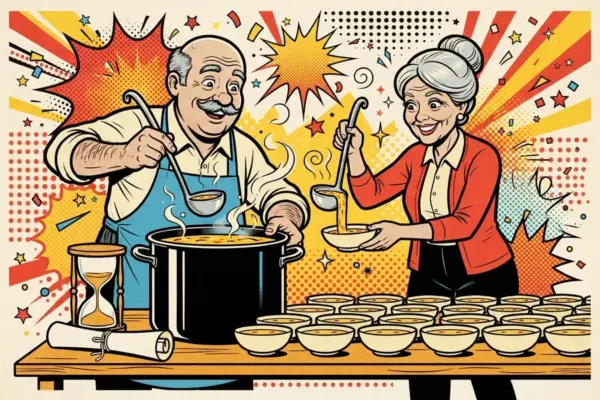
Soup Pot
«You trust a full pot and a plan everyone can read.»
The test is new — you are among the first hundred to take it.
You ladle soup for everyone at the long table, and the rota on the wall says who stirs next and who washes up. On running the economy you lean toward narrowing gaps together; on power over personal life, toward shared standards and respect for order.
Holding a group together is your strength, and a posted plan is how you do it. Each line slides, so landing near the middle is normal, and all four mixes turn up everywhere. That can also mean less room for anyone whose choices miss the plan.
Your answer to who stirs next is already on the wall.

Fruit Stall
«You'd rather build your own stall than borrow a plan.»
The test is new — you are among the first hundred to take it.
You pick your own pitch, your own hours and your own odd sign, and whatever the coins add up to is what the day was worth. On running the economy you lean toward letting outcomes settle themselves; on power over personal life, toward personal choice and openness.
You're good at trying things before anyone has approved them.
Since each line slides, sitting near the middle is normal, and all four mixes turn up among people you know. That can also mean less active correction when outcomes land unevenly. Nobody hands you a script, and you like it that way.

Brass Scales
«You trust a steady shop and a door that opens on time.»
The test is new — you are among the first hundred to take it.
You weigh each order on the brass scales, count the change twice and close at the posted hour. On running the economy you lean toward letting outcomes settle themselves; on power over personal life, toward shared standards and respect for order.
Predictability is your strength: the work is yours and the standards are known. That can also mean less room for anyone whose choices miss the shared standard. A crooked label across the shop catches your eye first.
Every line is a slope, so a near-middle mix is normal, and all four combinations are common. You like a shop where the scales tell the truth.
About this test
How this test works
Political words shift meaning between countries and languages, so this test avoids them and stays with everyday values: no named groups, public figures, laws or programs. The approach behind it describes a person on two independent dimensions instead of one. One covers how the economy gets run, from shared decisions that narrow gaps to outcomes that settle by themselves. The other covers who sets the standards for everyday conduct and customs, from individual choice to common standards.
Your answers on each line are added up separately, and the winning side of each line combines with the other into one of four positions. To do this, each line is forced into an either-or choice, although in life both are continuous and most people sit nearer the middle than either edge. A mixed result near the middle is therefore an ordinary one. For further reading, try an overview of the classic one-line view of politics and why it is often called too narrow, and an article on how stances get placed on charts, multi-axis versions among them.
The test belongs to no ready-made orientation tool and has no tie to one. It cannot tell you your party, it ranks none of the four outcomes, and it says nothing about your character.
Frequently asked questions
How accurate is a political compass test?
Treat it as a rough map. The two-axis idea has decades of research on how opinions cluster behind it, but what you take is a brief questionnaire about everyday scenes, so it shows the direction your answers lean and little beyond that. Mood and wording can move a few of them.
Is a political compass test scientifically valid?
Free short quizzes of this kind, popular ones included, do not publish the testing figures that a formal psychology scale comes with. The two dimensions underneath, one on economics and one on authority and social norms, do appear in peer-reviewed studies that use different methods. So the idea stands on solid ground while the quiz itself has no formal proof behind it.
What is the difference between a political compass and the left-right spectrum?
One line forces two different questions to share a single slot: how the economy should be run, and how far authority should reach into personal life. Someone can lean one way on the first and the other way on the second, and a single line would average them into a middle that describes neither. Studies find the two only loosely connected, so where you stand on one says little about the other.
Does a political compass test work the same in every country?
It is built to, but no quiz can promise it. The scenes here could happen in any household or club, with no parties, no public figures and no named measures, because political vocabulary is the shaky part: some terms point in almost opposite directions from one region to another, and views about the economy line up neatly in only a narrow group of countries.
What is the difference between liberal and left, or conservative and right?
"Liberal" sits on the left of the spectrum in some countries and, elsewhere, stands for open markets and a small government, which usually goes with the right. So the pairs are not interchangeable. One-word tags travel badly, which is why this quiz describes each line by what it asks people to weigh.
Sources
- Eysenck, H. J. (1954). The Psychology of Politics. London: Routledge & Kegan Paul.
- Treier, S., & Hillygus, D. S. (2009). The Nature of Political Ideology in the Contemporary Electorate. Public Opinion Quarterly, 73(4), 679–703.
- Feldman, S., & Johnston, C. D. (2014). Understanding the Determinants of Political Ideology: Implications of Structural Complexity. Political Psychology, 35(3), 337–358. doi:10.1111/pops.12055.
Three more tests on the same theme


Breakdown
There's a reason you answer the way you do
Most tests show you a slice of who you are. This one gets to the core: the classic 16-type personality test that goes back to Carl Jung, rebuilt from the ground up and way more accurate. It takes ten minutes, you only ever do it once — and you walk away with an answer most people never quite figure out: why you are the way you are. Why some people just get you, and why with others it's complicated. And that answer won't change: your type is yours for life.
Take the free testHow you compare
The test is new — you are among the first hundred to take it.
Three more tests on the same theme
About this test
How this test works
Political words shift meaning between countries and languages, so this test avoids them and stays with everyday values: no named groups, public figures, laws or programs. The approach behind it describes a person on two independent dimensions instead of one. One covers how the economy gets run, from shared decisions that narrow gaps to outcomes that settle by themselves. The other covers who sets the standards for everyday conduct and customs, from individual choice to common standards.
Your answers on each line are added up separately, and the winning side of each line combines with the other into one of four positions. To do this, each line is forced into an either-or choice, although in life both are continuous and most people sit nearer the middle than either edge. A mixed result near the middle is therefore an ordinary one. For further reading, try an overview of the classic one-line view of politics and why it is often called too narrow, and an article on how stances get placed on charts, multi-axis versions among them.
The test belongs to no ready-made orientation tool and has no tie to one. It cannot tell you your party, it ranks none of the four outcomes, and it says nothing about your character.
Frequently asked questions
How accurate is a political compass test?
Treat it as a rough map. The two-axis idea has decades of research on how opinions cluster behind it, but what you take is a brief questionnaire about everyday scenes, so it shows the direction your answers lean and little beyond that. Mood and wording can move a few of them.
Is a political compass test scientifically valid?
Free short quizzes of this kind, popular ones included, do not publish the testing figures that a formal psychology scale comes with. The two dimensions underneath, one on economics and one on authority and social norms, do appear in peer-reviewed studies that use different methods. So the idea stands on solid ground while the quiz itself has no formal proof behind it.
What is the difference between a political compass and the left-right spectrum?
One line forces two different questions to share a single slot: how the economy should be run, and how far authority should reach into personal life. Someone can lean one way on the first and the other way on the second, and a single line would average them into a middle that describes neither. Studies find the two only loosely connected, so where you stand on one says little about the other.
Does a political compass test work the same in every country?
It is built to, but no quiz can promise it. The scenes here could happen in any household or club, with no parties, no public figures and no named measures, because political vocabulary is the shaky part: some terms point in almost opposite directions from one region to another, and views about the economy line up neatly in only a narrow group of countries.
What is the difference between liberal and left, or conservative and right?
"Liberal" sits on the left of the spectrum in some countries and, elsewhere, stands for open markets and a small government, which usually goes with the right. So the pairs are not interchangeable. One-word tags travel badly, which is why this quiz describes each line by what it asks people to weigh.
Sources
- Eysenck, H. J. (1954). The Psychology of Politics. London: Routledge & Kegan Paul.
- Treier, S., & Hillygus, D. S. (2009). The Nature of Political Ideology in the Contemporary Electorate. Public Opinion Quarterly, 73(4), 679–703.
- Feldman, S., & Johnston, C. D. (2014). Understanding the Determinants of Political Ideology: Implications of Structural Complexity. Political Psychology, 35(3), 337–358. doi:10.1111/pops.12055.
