
Am I Weird Quiz
Quick scenes from everyday life, five minutes, and one honest answer to how much your everyday pattern actually diverges from the people around you — not a score to brag about, just a clear picture.
No sign-up. Your result right away.

House Blend
«You've never needed to be the different one.»
The test is new — you are among the first hundred to take it.
Someone asks for a group order and yours matches everyone else's before you've even glanced at the menu. Your opinions slide easily next to your friends' opinions, your Friday nights look like theirs, and nothing about that feels like a compromise.
That's the strength: you slide into new rooms without friction, and group decisions rarely cost you anything. The flip side is a muscle you haven't had much reason to build — holding a minority opinion, or letting an odd reaction show, isn't yet a habit, since matching the room gets all the practice.
None of that comes from needing everyone's approval, and it doesn't mean you couldn't stand apart when it mattered — blending has simply logged more practice than standing out. The pattern sits close to the room today, with room left to move.

Secret Ingredient
«Blending in is your default, not your ceiling.»
The test is new — you are among the first hundred to take it.
At the party, you're blending in with the small talk for most of the night, and then somewhere around dessert you unpin the little enamel flower from under your collar and let someone notice it, just this once, not a whole personality.
That's the real strength here: you can blend in when it's useful, and let the odd flash through when it actually matters more. From the outside, that selectivity can look like indecision instead of a stance, simply because it hasn't hardened into a pattern yet — and the score doesn't say which corner of your life is carrying it.
That's not a flaw in the pattern — it's a working style, dipping into the version of you that fits and dropping it when it stops being useful. The flower stays pinned under the collar until the moment it's worth showing.

Open Door
«You never quite settle on one side of the door.»
The test is new — you are among the first hundred to take it.
You're halfway through the doorway when it happens — one hand still touching the doorknob of the party you were blending into, one foot already out on the balcony where the conversation gets stranger and louder.
The strength is real: you can draw on either mode depending on what a moment actually calls for, without either one running the show. If there's a shadow, it's that this level has the thinnest single throughline to point to — not because anything's hidden, just because the pattern is honestly still unsettled rather than quietly leaning somewhere unnamed. It won't say which part's pulling which way.
An honestly split pattern is still a real pattern, not a placeholder while you make up your mind. You're running both modes at once, switching depending on the room. Why pick a side when both genuinely fit?
Window Garden
«Standing apart from the room is just Tuesday for you.»
The test is new — you are among the first hundred to take it.
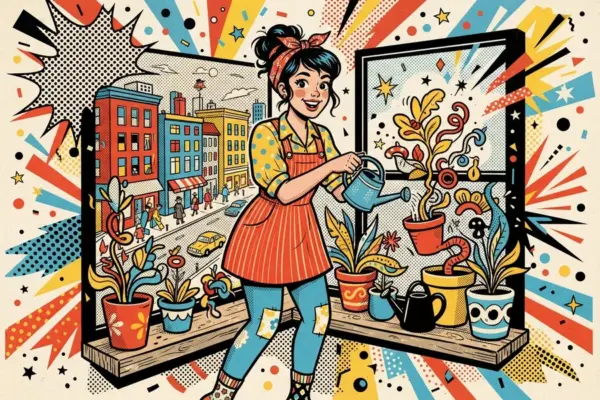
You're out on the fire escape before breakfast, watering a windowsill of plants nobody else on the block would bother growing, in exactly the outfit you slept in, without a single thought about who's watching from the street below.
This is a settled comfort with standing apart, not a performance of it — the same motivational pattern researchers tie to resisting majority pressure and treating being different as an asset. It shows up early, before anyone's awake to react to it. The shadow: rooms built for blending in ask more conscious effort from you than from someone whose default already matches — and none of that is evidence of social difficulty, since fear-driven avoidance is a separate, unmeasured axis.
Keep watering it — this garden of yours was never going to look like the neighbors'.
Full Volume
«The room's expectations barely reach you at all.»
The test is new — you are among the first hundred to take it.
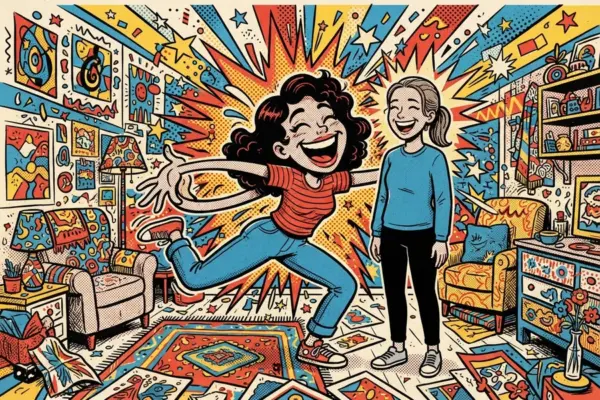
You're dancing full-out in the middle of the living room, arms flung wide, unbothered that your friend is standing right there watching, laughing, not needing you to tone any of it down for her sake.
What you're carrying is a strong version of a pattern that research on comfort-with-difference frames as a genuine positive trait — and long-running work on people like this finds them no more prone to distress than most.
The parts of life that blending smooths over for other people — quick alignment, low friction in a new room — take more effort for you, since blending was never your default. None of this points to isolation, distress, or the clinical slice some assume 'this different' means — and feeling like the only one wired this way is itself a documented trick of perception. Full volume, plenty of company.
About this test
How this test works
This test doesn't pull from one named personality inventory. It blends several separately studied everyday habits, all tied to going against the grain, into a single reading — there's no one official trait behind the score.
It tracks how comfortable you are letting a personal preference show, whether you hold your ground when the room disagrees, how open you are to ideas that don't fit the usual mold, and whether your behavior stays consistent across settings.
It does not measure social anxiety or fear-based avoidance — a separate pattern this test doesn't touch. Like any self-report tool, it reads a present-day pattern, not a permanent trait or a diagnosis. It also can't say what counts as standing out in general — that's read against whichever room you're actually in, never some one-size-fits-all standard.
Further reading: nonconformity and eccentricity. Treat the result as a mirror, not a verdict.
Frequently asked questions
Is it normal to feel weird sometimes?
Yes — nearly everyone catches themselves out of step with a room now and then. What this test is actually built to spot is a repeating shape across eighteen different everyday scenes, not just today's mood.
Is being weird a good or a bad thing?
Neither, by design. The habits this test tracks — comfort with standing out, holding your own judgment, curiosity about the unconventional, behaving the same everywhere — show up in their own research as neutral or even favorable qualities. None of the five results here is written as a bad outcome.
What does it actually mean when someone calls a person weird?
Less than the word suggests. There's no single trait in the research literature that goes by that name — it's a catch-all people reach for to cover a handful of separate things: unusual taste, blunt honesty, an offbeat idea, an uneven habit. This quiz adds up a few of those separately studied patterns into a single score, rather than pinning it all on one named quality.
Who counts as a weird person?
Whoever doesn't match the room they're standing in — which means the answer shifts depending on the room itself. Someone who stands out at a formal dinner might be the most ordinary person at their own family's table. What matters here is your pattern held up against your own everyday surroundings, never one blanket yardstick everyone gets measured against.
Sources
- Snyder, C. R., & Fromkin, H. L. (1977). Abnormality as a positive characteristic: The development and validation of a scale measuring need for uniqueness. Journal of Abnormal Psychology, 86(5), 518–527.
- Imhoff, R., & Erb, H.-P. (2009). What motivates nonconformity? Uniqueness seeking blocks majority influence. Personality and Social Psychology Bulletin, 35(3), 309–320. doi:10.1177/0146167208328166.
- McCrae, R. R., & Costa, P. T. - Openness to Experience (Big Five / NEO-PI-R).
- Weeks, D., & James, J. (1995). Eccentrics: A Study of Sanity and Strangeness. Weidenfeld & Nicolson / Villard.
Three more tests on the same theme



Breakdown
There's a reason you answer the way you do
Most tests show you a slice of who you are. This one gets to the core: the classic 16-type personality test that goes back to Carl Jung, rebuilt from the ground up and way more accurate. It takes ten minutes, you only ever do it once — and you walk away with an answer most people never quite figure out: why you are the way you are. Why some people just get you, and why with others it's complicated. And that answer won't change: your type is yours for life.
Take the free testHow you compare
The test is new — you are among the first hundred to take it.
Three more tests on the same theme
About this test
How this test works
This test doesn't pull from one named personality inventory. It blends several separately studied everyday habits, all tied to going against the grain, into a single reading — there's no one official trait behind the score.
It tracks how comfortable you are letting a personal preference show, whether you hold your ground when the room disagrees, how open you are to ideas that don't fit the usual mold, and whether your behavior stays consistent across settings.
It does not measure social anxiety or fear-based avoidance — a separate pattern this test doesn't touch. Like any self-report tool, it reads a present-day pattern, not a permanent trait or a diagnosis. It also can't say what counts as standing out in general — that's read against whichever room you're actually in, never some one-size-fits-all standard.
Further reading: nonconformity and eccentricity. Treat the result as a mirror, not a verdict.
Frequently asked questions
Is it normal to feel weird sometimes?
Yes — nearly everyone catches themselves out of step with a room now and then. What this test is actually built to spot is a repeating shape across eighteen different everyday scenes, not just today's mood.
Is being weird a good or a bad thing?
Neither, by design. The habits this test tracks — comfort with standing out, holding your own judgment, curiosity about the unconventional, behaving the same everywhere — show up in their own research as neutral or even favorable qualities. None of the five results here is written as a bad outcome.
What does it actually mean when someone calls a person weird?
Less than the word suggests. There's no single trait in the research literature that goes by that name — it's a catch-all people reach for to cover a handful of separate things: unusual taste, blunt honesty, an offbeat idea, an uneven habit. This quiz adds up a few of those separately studied patterns into a single score, rather than pinning it all on one named quality.
Who counts as a weird person?
Whoever doesn't match the room they're standing in — which means the answer shifts depending on the room itself. Someone who stands out at a formal dinner might be the most ordinary person at their own family's table. What matters here is your pattern held up against your own everyday surroundings, never one blanket yardstick everyone gets measured against.
Sources
- Snyder, C. R., & Fromkin, H. L. (1977). Abnormality as a positive characteristic: The development and validation of a scale measuring need for uniqueness. Journal of Abnormal Psychology, 86(5), 518–527.
- Imhoff, R., & Erb, H.-P. (2009). What motivates nonconformity? Uniqueness seeking blocks majority influence. Personality and Social Psychology Bulletin, 35(3), 309–320. doi:10.1177/0146167208328166.
- McCrae, R. R., & Costa, P. T. - Openness to Experience (Big Five / NEO-PI-R).
- Weeks, D., & James, J. (1995). Eccentrics: A Study of Sanity and Strangeness. Weidenfeld & Nicolson / Villard.
